

Buyer's Guide — Steering System
Steering Rack Problem Symptoms: How to Tell It Needs Replacing
Loose steering, a fluid leak, or a knock over bumps can all point to a failing steering rack — but they can also point to something cheaper to fix. This guide explains what each of the five common signs actually means inside the rack, how to avoid misdiagnosing a different fault, and when a rack should be replaced outright rather than repaired.
Diagnostic Checklist
The 5 signs a steering rack is failing.
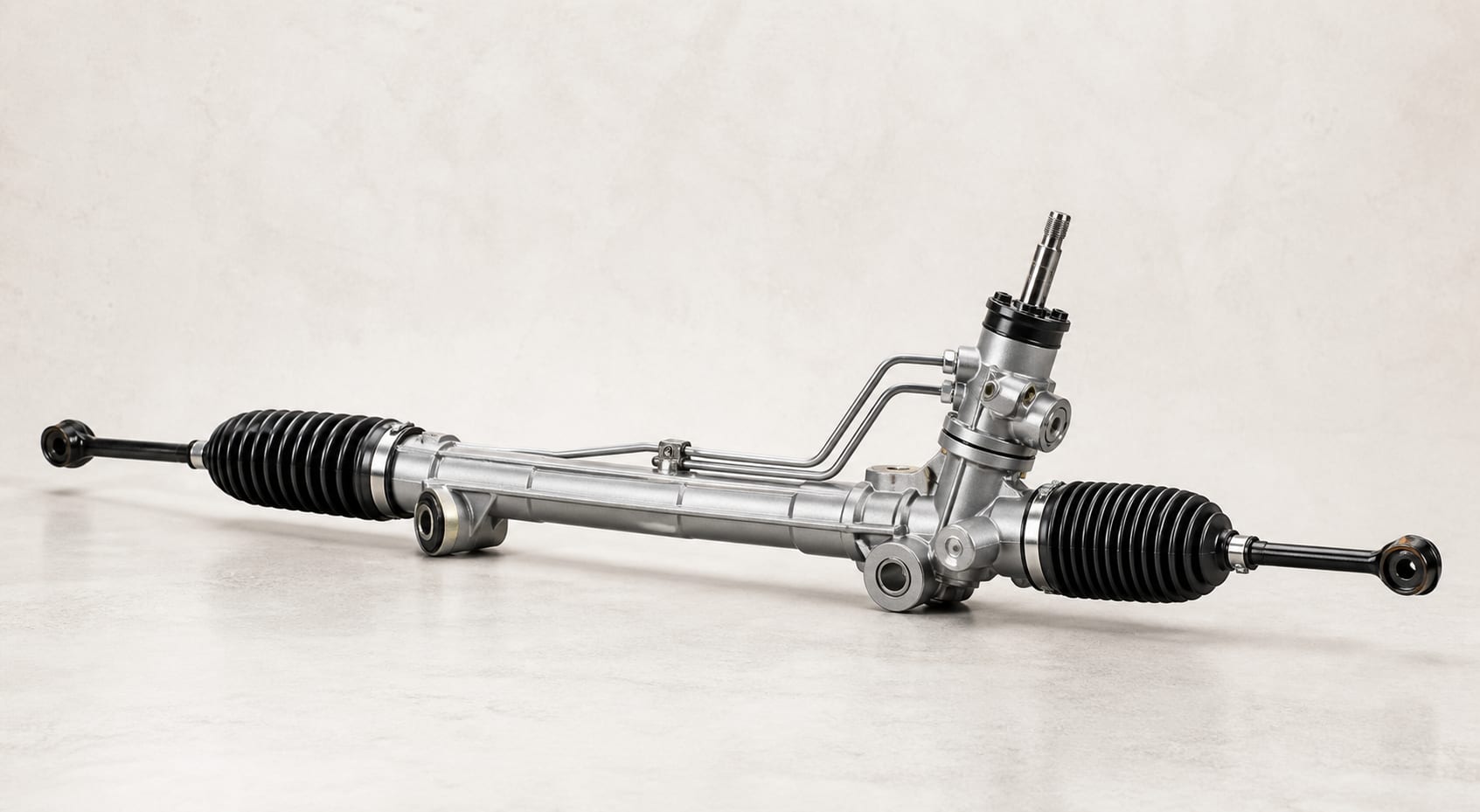
Our steering rack page lists five signs to watch for when advising a customer. Here's what's likely happening inside the rack when each one shows up — useful when you need to explain the fault, not just spot it.
| Symptom | Likely internal cause |
|---|---|
| Excessive free play or looseness in the steering wheel | Usually points to wear inside the rack-and-pinion mesh itself, or worn rack-end bushings — internal clearance builds up before the wheels fully respond to steering input. |
| Power steering fluid leaking from the rack boots | Typically worn rack boots or seals at the ends of the housing, letting hydraulic fluid escape — a strong indicator the boot or an internal seal has failed, not just a loose clamp. |
| Knocking or clunking noise over uneven roads | Often traced to worn rack-end bushings or the ball joints connecting the rack to the tie rods, letting the assembly shift slightly under load. |
| Steering feels heavy or uneven when turning | On hydraulic racks, this can point to worn internal valve or pump components restricting fluid pressure; on EPS racks, it can indicate an internal electric-assist fault within the rack itself. |
| Uneven front tyre wear despite correct alignment | If alignment keeps drifting out of spec after being corrected, a bent rack shaft or worn internal components can be pulling the geometry back out — worth checking once alignment alone doesn't hold. |
Don't misdiagnose these first
Several other faults look similar to a failing steering rack from the driver's seat. Ruling them out first — or confirming they're also present — helps you avoid quoting the wrong part.
- Worn tie-rod ends: clunking or looseness that's usually isolated to one side, often paired with a visibly worn or torn ball-joint boot on inspection — a narrower, cheaper fix than a rack.
- Low power steering fluid: heavy or noisy steering that often eases once fluid is topped up — if heaviness disappears after a refill, the fluid was the cause, not the rack.
- Wheel misalignment: uneven tyre wear and a wheel sitting off-centre at rest, typically without the looseness, knocking or fluid leaks that point to the rack.
When it's likely the rack
A steering rack fault is a stronger possibility when two or more of the five signs above show up together — for example, a fluid leak alongside knocking, or looseness that doesn't improve after a fluid top-up and isn't isolated to one side.
Treat this as a strong indicator, not a certain diagnosis. A physical inspection before ordering a part avoids an unnecessary return — this is the same reason every steering rack inquiry to a wholesale steering rack supplier should go through application verification before a quote is finalised.
Repair vs Replace
Repair vs replace — when a rack should be replaced outright.
Once a steering rack's boots or seals have failed, or wear has reached the internal rack-and-pinion mesh or valve components, the standard route in most wholesale and workshop contexts is a whole-unit replacement rather than repairing the individual seal or component. A steering rack is a sealed, safety-critical assembly — that's also why we supply complete rack units rather than individual seals or components, and why fitment should go through a qualified workshop rather than a DIY repair.
Before you commit to an order, it's worth comparing quotations properly. If you're already lining up a wholesale steering rack supplier, see what a replacement will cost to quote, and read how we verify applications before confirming a replacement.
Confirm the Fault
Confirm the fault and get a wholesale quote.
If two or more of the signs above match, send us the details on WhatsApp — our Malaysia sales team will confirm the likely fault and quote a replacement.
Confirm the Fault on WhatsAppGet Quoted Fast
What to send us to confirm and get a fast quote.
Symptoms FAQ
Common questions.
What does a failing steering rack sound like?
A worn steering rack often produces a knocking or clunking noise when turning over bumps or potholes, usually caused by worn internal bushings or the ball joints where the rack meets the tie rods. A whining noise while turning can also point to a struggling hydraulic pump. Confirm with a professional inspection before ordering a replacement.
Can a steering rack be repaired, or does it need full replacement?
In most wholesale and workshop contexts, a leaking rack boot or worn internal components means the whole unit is replaced rather than repaired piece by piece — that is how steering racks are typically supplied and serviced. It is a sealed, safety-critical assembly, so replacement is the standard route once internal wear is confirmed.
Is steering wheel looseness always a steering rack problem?
Not always. Looseness can also come from worn tie-rod ends or ball joints outside the rack itself, or from a low power steering fluid level. If the play is isolated to one side, or it improves after topping up fluid, the rack itself may not be the cause — a workshop inspection can confirm before you order a part.
How urgent is it to replace a leaking steering rack?
Treat a leaking steering rack as urgent. On hydraulic systems, continued fluid loss can lead to a sudden loss of power assist and, over time, further internal wear. Since steering is a safety-critical system, a leaking rack should be scheduled for inspection and likely replacement rather than left to run down.
Can I confirm the fault without bringing the car in?
Often, yes, for the purpose of getting a quote. Send us the symptom observed, the vehicle make, model and year, and the OE number or a photo of the old rack on WhatsApp — we can confirm the likely application and give you a wholesale quote, though a physical inspection still confirms the exact fault before fitment.
Next Step
Get your steering rack quote today.
Send your OE number, vehicle details or the symptom you're seeing on WhatsApp — our Malaysia sales team confirms the likely fault and replies with a wholesale quote.
Get a Wholesale Quote on WhatsAppRelated